
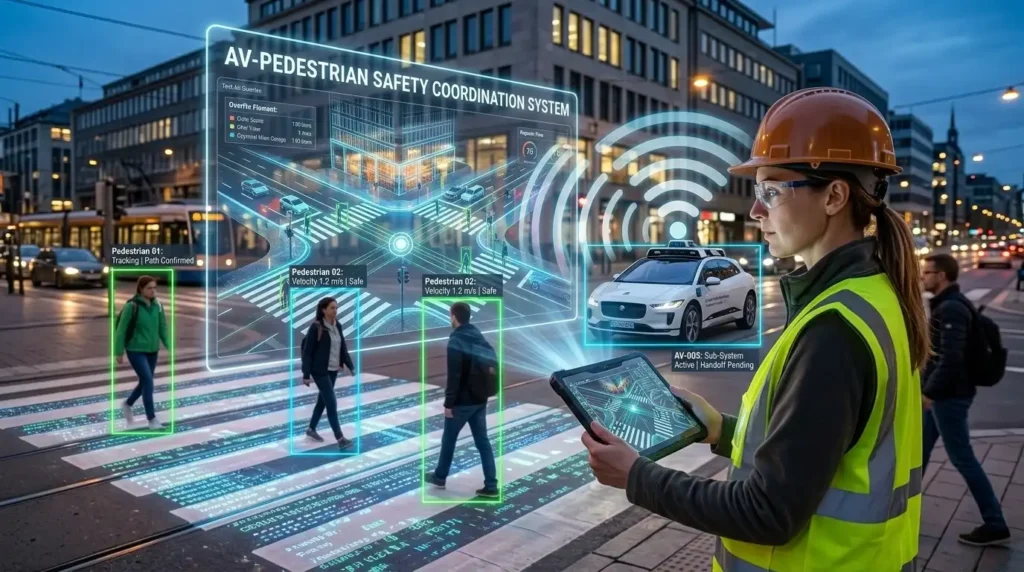
Walking through a bustling city intersection has historically relied on a simple premise: a painted white line, a flashing light, and the hope that drivers are paying attention. However, as urban populations grow and distracted driving remains a pervasive threat, this basic infrastructure is no longer sufficient. In 2026, we are witnessing a massive transformation in urban mobility. The rise of smart pedestrian crossing systems is reshaping how we navigate our streets. By replacing outdated fixed-timing lights with Artificial Intelligence (AI) and Vehicle-to-Everything (V2X) communication, cities are moving from reactive traffic control to proactive pedestrian protection.
The Current Crisis and the Push for Innovation
 For years, pedestrian fatalities have been a critical issue, particularly at signalized crossings and during low-visibility conditions. The traditional crosswalk is blind; it operates on a set timer regardless of whether an elderly person needs an extra ten seconds to cross or if a massive crowd is spilling into the street. Extended wait times during off-peak hours often promote jaywalking, while rigid signal times during rush hour can leave walkers stranded in the middle of a busy thoroughfare.
This rigid system is being completely rethought as communities worldwide strive to eradicate traffic fatalities and serious injuries. The solution isn’t just brighter lights or louder beeps—it is an injection of high-level intelligence into our road infrastructure.
AI-Powered Real-Time Sensing: The Brains of the Crosswalk
The most significant upgrade in 2026 is the integration of AI-driven pedestrian detection and adaptive signal timing. Legacy detection systems are rapidly being replaced by high-precision cameras, radar equipment, and 3D digital lidar systems.
These smart systems can accurately recognize and track a multitude of variables in real-time. For instance, the technology can identify:
- The exact number of pedestrians waiting, their walking speed, and how long they have been waiting.
- Specific crowd dynamics, such as large groups of students or tourists.
- Vulnerable road users who may require more time, including the elderly and individuals with limited mobility.
- Unusual actions or abnormal behaviors that could indicate an impending safety risk before an accident occurs.
Once this data is captured, the system’s edge AI processes it instantly. It automatically adjusts the duration of the green light, updates countdown timers, and triggers warning signals without any manual intervention. The results are profound: AI-enabled smart pedestrian crossing systems can reduce pedestrian waiting times by more than 40% compared to traditional fixed-time crossings. This creates a win-win scenario, as it also lowers vehicle delays at intersections, improving overall traffic flow and discouraging risky jaywalking behaviors.
V2X Connectivity: The Invisible Safety Net
While AI makes the crosswalk smarter, V2X makes the entire intersection aware. Vehicle-to-Everything (V2X) technology has become a standard feature in advanced smart pedestrian crossing systems by 2026. This technology serves as a bridge, translating high-fidelity perception from roadside sensors into standardized messages that approaching vehicles can actually use.
Here is how the V2X safety buffer actively protects walkers:
- As soon as a pedestrian steps into or waits at a crosswalk, the platform immediately sends safety alerts to connected cars, smart buses, and self-driving systems.
- Human drivers receive in-vehicle warnings well before they make visual contact with the pedestrian, granting them critical extra seconds to react.
- Autonomous vehicles receive these alerts and can slow down or apply the brakes in advance.
This technology is especially crucial because it compensates for visual blind spots and cognitive limitations in long-tail scenarios, such as extreme weather or sudden traffic incidents. Systems like Ouster BlueCity capture the precise geolocation, speed, and trajectory of all road users in 3D, broadcasting this data as Basic Safety Messages via Roadside Units. This capability allows vehicles to essentially “see” around corners or through heavy fog, warning drivers of pedestrians before they even enter their field of vision. The impact on safety is massive; experts suggest V2X could improve reliability in complex road conditions by a factor of 10.
Connecting Pedestrians Directly: The Power of V2P
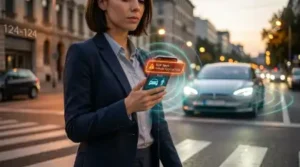 The connectivity doesn’t end with infrastructure and vehicles; pedestrians themselves are becoming active participants in this digital ecosystem. Through Vehicle-to-Pedestrian (V2P) communication, cars can spot people in crosswalks using their smartphones or wearables. A pedestrian could receive a warning directly on their phone about an approaching car that hasn’t slowed down, providing a critical back-and-forth communication channel. This mutual awareness is a monumental step forward, especially given that almost 270,000 pedestrians die in traffic accidents worldwide each year.
These systems rely heavily on robust protocols like Cellular V2X (C-V2X), which is built on 4G and 5G standards. C-V2X enables the low-latency, localized data exchanges needed for split-second safety functions such as crash avoidance and red-light warnings. Because C-V2X links vehicles to the cloud and to one another across greater distances, hazard data can move seamlessly through the system, enabling coordinated decisions across entire city networks.
Privacy and Processing: Edge Computing in Smart Cities
A common concern when introducing high-definition cameras and tracking radar to public streets is the potential invasion of privacy. Fortunately, the architecture of 2026’s smart crossings addresses this head-on. Many of these Vision AI solutions operate entirely at the edge, meaning data is processed locally at the intersection without needing a network connection to a centralized server for processing.
These edge-based systems are privacy-preserving by design, ensuring full GDPR compliance with no personal data ever stored or transmitted. They operate in a privacy-first mode where they detect, count, and calculate wait times without transmitting any images. The technology is designed to understand the geometry and flow of human traffic to predict risk, not to monitor the identities of individual citizens.
The Road Ahead: From Concept to Connected Reality
As of 2026, V2X has moved well beyond technical validation and small proof-of-concept tests. We are now entering a phase of large-scale pilot deployments and standardizations across multiple cities. With multiple massive infrastructure projects launched, 2026 is widely seen as the critical inflection point where the technology transitions from demonstration projects to scalable replication.
Traffic management centers are utilizing these integrated networks to monitor potential conflict points in real-time, allowing city planners to spot dangerous intersections and improve road layouts dynamically based on actual usage data. The integration of digital lidar with V2X communication is actively redefining the “Smart City” from a theoretical concept into a connected reality. By providing a “digital twin” of the roadway that remains accurate despite challenging weather, agencies can move past fragmented, reactive fixes and establish a unified path toward Vision Zero. Transportation leaders now have the tools to build a proactive infrastructure that not only observes the world but communicates insights directly to vehicles and pedestrians to prevent accidents before they occur.
The numbers back up the investment. Pilot programs have shown that V2X integration can reduce the takeover rate of urban autonomous navigation systems by 60% and improve overall traffic efficiency by up to 30%. Furthermore, communication latency in these Vehicle-Road-Cloud systems has been reduced to as low as 5 milliseconds—approximately 40 times faster than human reaction time—providing a rock-solid foundation for millisecond-level collaborative perception and decision-making.
The transition from a passive painted line on the asphalt to an intelligent, communicative safety hub marks a monumental leap forward for pedestrian rights and safety. By integrating AI perception with real-time connectivity, our cities are finally building an urban environment where the infrastructure actively works to protect its most vulnerable users.