
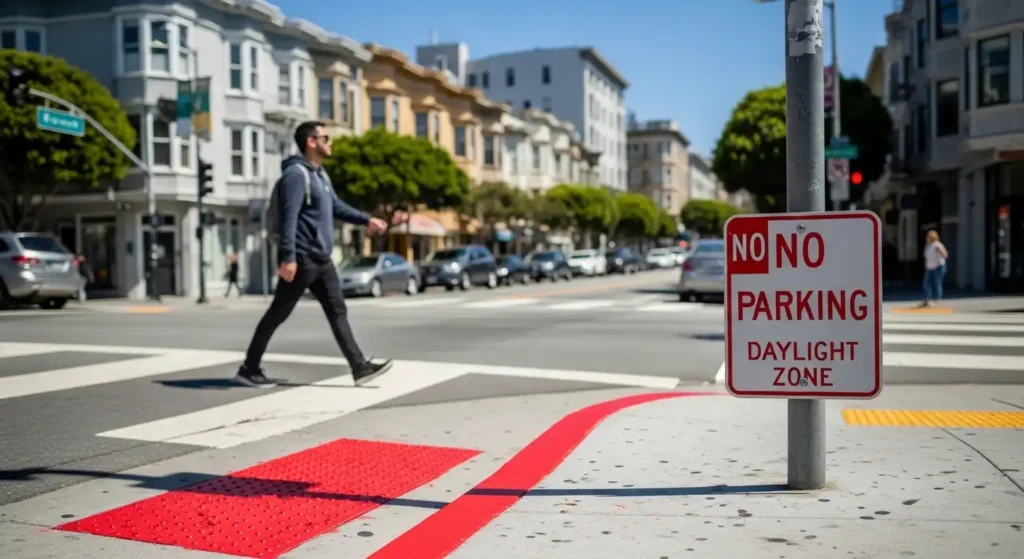
If you live in San Francisco, you’ve likely noticed a new splash of color at your neighborhood intersections: The Red Zone. As of April 2026, the SFMTA has completed a massive safety overhaul of the High Injury Network, installing over 440 “daylighting” zones across 925 intersections. What was once a convenient parking spot near the corner is now a guaranteed ticket—and a vital tool for saving lives.
At pedestrianlife.net, we advocate for walkable, visible streets. The 2026 universal enforcement of California’s daylighting mandate (AB 413) is perhaps the most significant “simple” fix for pedestrian safety in a decade. By removing parked cars from the 20 feet leading up to a crosswalk, we are finally solving the “visual obstruction” crisis that has plagued our city’s hills and corners.
What is “Daylighting”?
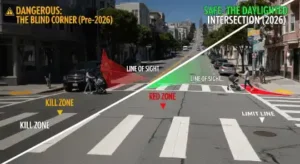 Daylighting is a simple urban design principle: remove the visual barriers at intersections. When a large SUV or van parks right at the edge of a crosswalk, it creates a “blind zone.” A driver cannot see a pedestrian entering the street, and the pedestrian cannot see oncoming traffic until they are already in the “kill zone.”
The 2026 data is already in. According to the SFMTA’s March 2026 report, intersections with proper daylighting and limit lines have seen pedestrian-vehicle close calls drop by 49%. By creating space between those walking and those driving, we are giving everyone more time to react.
The 2026 Enforcement Surge: No More Warnings
During the roll-out in late 2024 and 2025, many drivers received warnings or “grace period” notices. In 2026, the gloves are off. San Francisco parking enforcement is now strictly citing any vehicle parked within 20 feet of the approach side of a crosswalk—whether the curb is painted red or not.
Under the 2026 California standards, the law applies to:
- Marked and unmarked crosswalks.
- All approach sides of the intersection.
- Vehicles of all sizes (though larger vehicles are the primary targets for obstruction).
Connecting the Safety Dots: A Network of Protection
Daylighting doesn’t work in a vacuum. It is part of a 2026 “Safety Suite” that includes reduced school zone speed limits (now 20 mph under AB 382) and the expansion of automated speed enforcement. Much like how autonomous vehicles are held to 10-minute response rules, human drivers are now being held to a “Sightline Responsibility” standard.
This push for visibility mirrors other 2026 safety movements. For instance, the new e-bike visibility requirements ensure that riders are seen from behind, just as daylighting ensures pedestrians are seen from the side. Even in high-risk environments like balcony repair sites, the 2026 theme is the same: Removing the hidden hazard before it leads to a fall or a collision.
How to Support Daylighting in Your Neighborhood
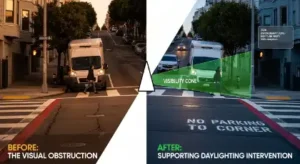 While the SFMTA has hit nearly 1,000 intersections, thousands more remain “dimly lit” by parked cars. If you have a corner in your neighborhood where you feel “blind” while crossing, you can now use the 2026 “Safe Streets” portal to request daylighting paint.
Pedestrian Tip: When crossing at a daylighted intersection, still pause at the “limit line.” These new white lines are set back from the crosswalk to give turning trucks and buses enough “swing room” without encroaching on your space.
Conclusion: The End of the Blind Corner
The transition to a “Daylighted” San Francisco hasn’t been without growing pains—parking is harder to find than ever. But as pedestrian collisions drop by 32% citywide, the trade-off is clear. A parking spot is not worth a life. At pedestrianlife.net, we believe that 2026 will be remembered as the year we finally cleared the view and made the “Pedestrian Life” a safer one for everyone.