
Understanding Levels of Automation and Human Responsibility
 To determine who holds legal responsibility after an AV collision, courts first look at the vehicle’s level of automation as defined by the SAE International J3016 Standard. These technical tiers dictate whether a human driver or an automated system was legally responsible for monitoring the driving environment at the moment of impact:
- Levels 1 and 2 (Driver Assistance & Partial Automation): Features like adaptive cruise control or lane-centering assist the driver. However, the human operator remains fully obligated to monitor the road and intervene instantly. In these cases, liability almost always falls primarily on the human driver for failing to prevent the collision.
- Level 3 (Conditional Automation): The automated system controls the vehicle under specific conditions but may prompt the driver to take over. If a system glitch fails to provide sufficient warning time to the human, liability shifts toward the vehicle manufacturer or software developer.
- Levels 4 and 5 (High and Full Automation): Operating fully without human driver oversight—such as commercial robotaxis—the vehicle system handles all driving tasks. In these fully driverless collisions, liability centers on corporate manufacturers, software engineers, and fleet operators.
The Complex Web of Potentially Liable Parties
When an autonomous vehicle strikes a pedestrian due to a hardware or software glitch, a personal injury claim can involve multiple defendants:
1. Vehicle Manufacturers and Hardware Suppliers
If a collision is caused by a failing component—such as a defective LiDAR sensor, faulty camera lens, or inadequate braking actuator—the manufacturer can be held liable under product liability law. Plaintiffs must demonstrate that a manufacturing defect, design flaw, or failure to warn made the vehicle unreasonably dangerous for public roadways.
2. Software Developers and AI Engineers
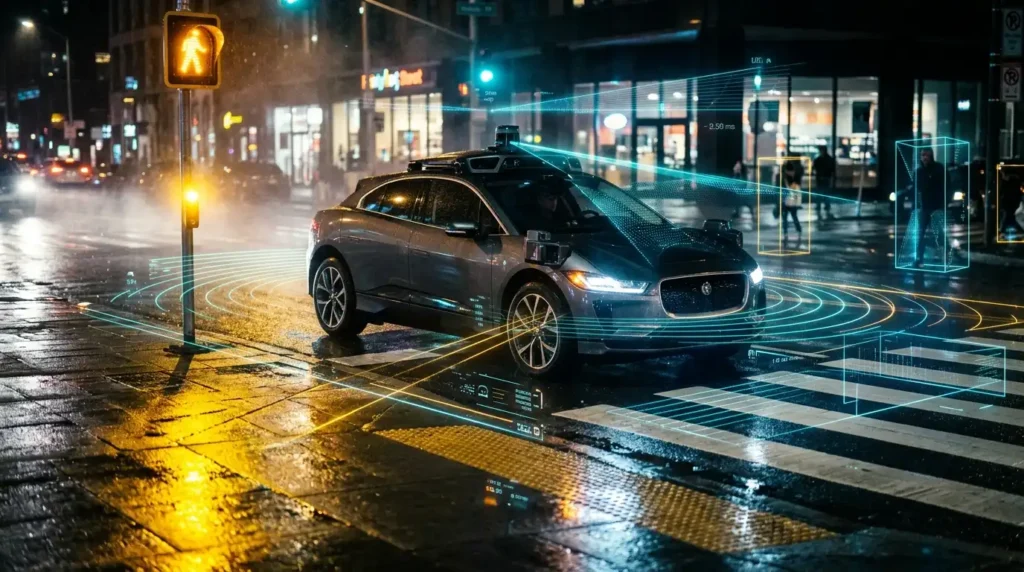
Self-driving software must process thousands of data points per second to identify human shapes, predict pedestrian motion, and execute emergency stops. If an algorithm fails to recognize a pedestrian wearing dark clothing at night or misinterprets a person pushing a bicycle, the software engineering firm behind the artificial intelligence may face claims for negligent software design.
3. Safety Drivers and Fleet Operators
Many commercial test vehicles retain a safety driver behind the wheel tasked with monitoring performance. If telemetry data proves the safety driver was distracted, checking a mobile device, or failing to react to system warning chimes, the safety driver—and their corporate employer via vicarious liability—can be held responsible.
4. Municipalities and Smart Infrastructure Providers
As smart cities integrate Connected Vehicle (V2X) infrastructure, street-level sensors transmit traffic signal status and pedestrian presence directly to approaching cars. If corrupted data feeds or neglected municipal infrastructure contribute to an AV failure, local government agencies or third-party contractors may bear partial fault.
Federal Safety Oversight and Evidence Recovery

The regulatory landscape for autonomous technology continues to evolve rapidly. The National Highway Traffic Safety Administration (NHTSA) maintains Standing General Orders requiring manufacturers and operators of Level 2 through Level 5 automated systems to report crash incidents promptly. These mandatory disclosures ensure crucial crash data is preserved for safety investigations and legal claims.
In the aftermath of a pedestrian strike, securing onboard digital evidence is the most critical step in proving negligence. Key evidentiary assets include:
- Event Data Recorders (EDR): Capturing vehicle speed, steering inputs, braking pressure, and system engagement status immediately prior to impact.
- LiDAR and Camera Sensor Logs: Providing a frame-by-frame visual record of what the vehicle’s computer perceived—or failed to perceive—as it approached the pedestrian.
- Disengagement Logs: Documenting the exact millisecond the autonomous system transferred manual control back to the human driver, revealing whether adequate reaction time was provided.
What to Do If You Are Struck by a Self-Driving Vehicle
If you or a loved one is involved in an accident with an autonomous or semi-autonomous car, taking decisive steps helps protect your physical health and legal rights:
- Seek Immediate Emergency Care: Prioritize medical evaluation, as shock can mask severe internal or neurological injuries.
- Ensure Police Document Technology Usage: Inform responding officers that the vehicle involved appeared to be operating autonomously or as a commercial test vehicle so it is recorded in the official report.
- Preserve Evidence at the Scene: If able, take photos and videos of the vehicle, visible sensor pods on the roof or bumpers, ambient street lighting, crosswalk markings, and surrounding traffic signals.
- Issue a Formal Spoliation Letter: Autonomous vehicle companies routinely overwrite digital sensor data. An attorney can immediately issue a legal spoliation letter demanding the manufacturer freeze and preserve all raw telematics data.
- Consult a Specialized Pedestrian Accident Attorney: AV personal injury litigation pits individuals against corporate tech giants and global automakers. Working with experienced legal counsel ensures hardware, software, and operational liabilities are thoroughly investigated.