
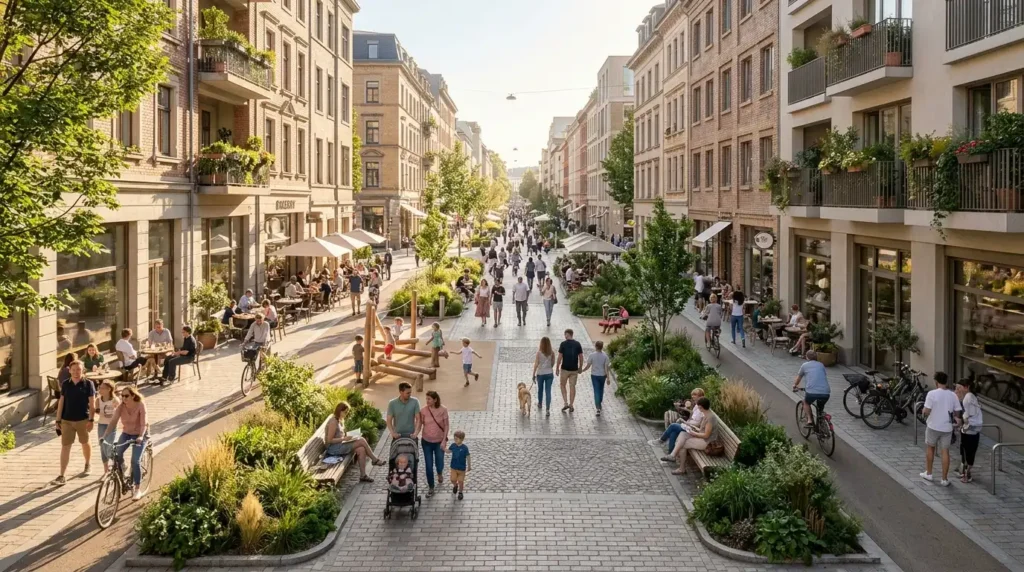
For nearly a century, urban street design revolved around a single priority: maximizing vehicle throughput and parking capacity. Sidewalks were squeezed to the margins, crosswalks were treated as secondary considerations, and public curb space was almost entirely dedicated to stationary private automobiles. However, a profound shift in modern city planning is quietly dismantling this automobile-centric paradigm.
Driven by urgent climate goals, rising traffic safety concerns, and a growing demand for livable communities, cities around the world are rethinking the purpose of the curb. By combining the hyper-local framework of the 15-minute city with data-driven infrastructure, modern urban development pedestrian safety initiatives are converting concrete roadways into vibrant, human-scaled spaces built for walking, rolling, and public life.
The 15-Minute City: Proximity as a Safety Strategy
Championed globally as an urban planning framework, the 15-minute city concept centers on a simple premise: all residents should be able to meet their daily needs—work, fresh food, healthcare, education, and recreation—within a short 15-minute walk or bike ride from their front door.
When daily amenities are decentralized and distributed evenly across polycentric neighborhood hubs, the necessity for multi-mile automobile commutes drops dramatically. This reduction in vehicle miles traveled (VMT) directly correlates with lower crash exposures for vulnerable road users. By shortening trip distances and lowering vehicle volumes on residential streets, the 15-minute model creates an environment where pedestrian-first infrastructure can thrive.
Rethinking Curb Space: From Parking to People
The curb is among the most valuable, underutilized real estate in any municipality. Historically viewed solely as a storage zone for passenger cars, smart curb management strategies are reallocating this flexible space to serve broader ecological and economic functions.
In accordance with design guidelines established by the National Association of City Transportation Officials (NACTO), progressive cities are deploying physical curb interventions to improve sightlines and shorten street crossing distances:
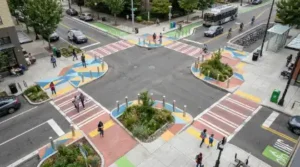
- Curb Extensions (Bulb-outs): Extending the sidewalk curb into former parking lanes visually and physically narrows the roadway. This forces motorists to reduce speeds while reducing pedestrian exposure time when crossing the street.
- Intersection Daylighting: Removing parking spaces within 20 feet of crosswalks and replacing them with bicycle corrals or low-profile planters restores critical sightlines between approaching drivers and pedestrians waiting to step off the curb.
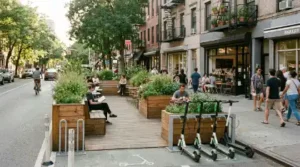
- Parklets and Pedestrian Plazas: Repurposing individual parking stalls into timber parklets, public seating zones, and outdoor dining space increases foot traffic, boosts local business revenue, and acts as a natural traffic calming buffer.
- Bioswales and Rain Gardens: Integrating green stormwater infrastructure into curb cutouts captures surface runoff, filters urban pollutants, reduces localized flooding, and lowers the urban heat island effect.
Smart Infrastructure and Tactical Traffic Calming
Reclaiming the curb requires physical design interventions that enforce lower speeds and prioritize non-motorized movement. Modern street retrofits rely on tactical engineering features that dictate driver behavior through intuitive spatial cues:
1. Continuous Sidewalks & Raised Crosswalks
Traditional intersections force pedestrians to step down into vehicular space. Raised crosswalks bring the roadway up to sidewalk grade. This design acts as a vertical speed table while sending a clear physical signal that drivers are entering a slow-speed, pedestrian-priority zone.
2. Pedestrian Refuges & Safety Islands
On multi-lane arterial streets, mid-block pedestrian refuge islands split long crossings into two manageable stages. These physical barriers provide a safe refuge in the center of the roadway, allowing walkers to focus on negotiating one direction of vehicular traffic at a time.
3. Smart Signalization & Leading Pedestrian Intervals (LPI)
Adjusting traffic signal timing offers a low-cost, high-impact safety upgrade. Implementing Leading Pedestrian Intervals (LPIs) grants walk signals 3 to 7 seconds before parallel vehicular traffic receives a green light. This brief head start allows pedestrians to establish their presence within the crosswalk, significantly reducing turning vehicle conflicts.
The Economic and Social Dividends of Walkability
Skeptics often express concern that converting vehicle lanes and parking spots into pedestrian spaces damages local commercial vitality. However, urban economic data consistently proves the opposite. When streets are redesigned to prioritize human movement over vehicle storage, local economies experience sustained benefits:
- Increased Retail Foot Traffic: Walkers, bicyclists, and transit riders visit neighborhood commercial districts more frequently and spend more per month on aggregate than visitors who arrive exclusively by car.
- Improved Public Health: Safe, connected sidewalk networks encourage active transportation, reducing rates of cardiovascular disease, obesity, and sedentary lifestyle risks across all age demographics.
- Equitable Mobility for All Ages: Pedestrian-first infrastructure accommodates senior citizens, young children, wheelchair users, and parents pushing strollers, ensuring equitable mobility across the entire community.
Overcoming Retrofit Challenges on Suburban Corridors
While historic urban centers adapt naturally to 15-minute city frameworks, retrofitting wide, car-centric suburban arterial corridors presents unique engineering challenges. High-speed, multi-lane roads cannot be transformed overnight.
To bridge this gap, planners employ incremental “tactical urbanism”—using low-cost materials like quick-build bollards, high-visibility paint, and modular planters to test curb reallocations in real time. By measuring traffic flow, pedestrian volumes, and local merchant feedback during pilot phases, municipalities build community consensus and refine designs before committing capital to permanent concrete installations.
Building Cities for the Next Generation
The transformation of our city streets from high-speed vehicular conduits into vibrant, human-scale places represents a necessary evolution in modern civil engineering. By pairing the proximity-based vision of the 15-minute city with smart, protective curb design, urban planners are crafting neighborhoods that are safer, healthier, and economically resilient.
Reclaiming the curb is ultimately about restoring balance to the public realm—ensuring that our shared streets serve the safety, health, and dignity of every person who walks, rolls, and lives within them.